Zimbabwean shoppers are some of the most resourceful in the region. Many of us have bought from a relative coming back from Johannesburg, ordered from an online store in South Africa, or tried importing from China. Each route can save money, and each can go wrong.
Smart sourcing means choosing the right route for each item, not always chasing the lowest sticker price. This guide compares the three main options and explains how to work out what an item really costs you.
The real cost is the landed cost
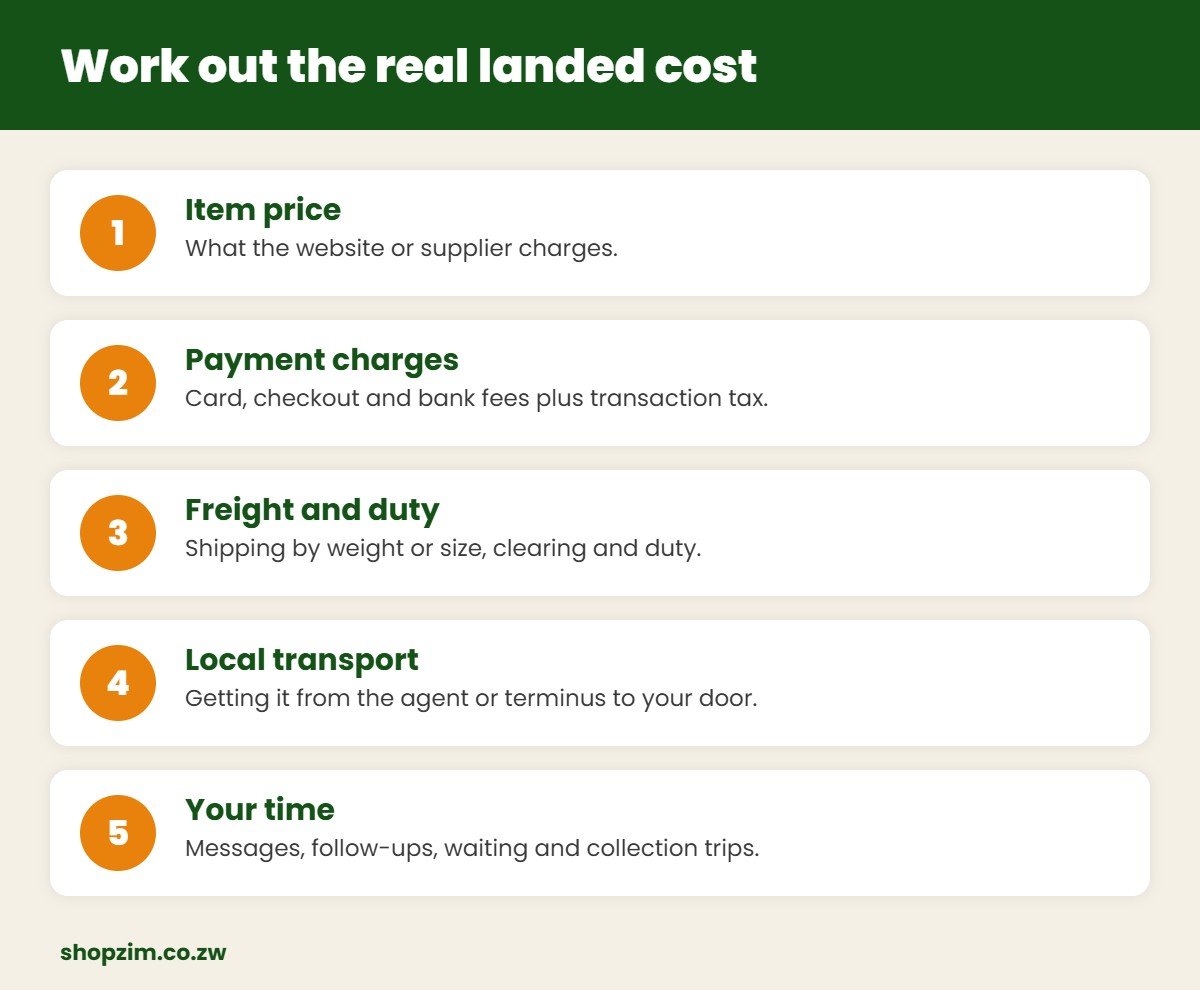
The price on a website is only the starting point. The landed cost is what the item actually costs by the time it is in your hands. It includes:
- The item price.
- Card, checkout and bank charges, plus any government transaction tax on your payment.
- Shipping or courier fees, often charged by weight or by size, whichever is greater.
- Duty and clearing charges at the border.
- Local transport from the agent’s warehouse or bus terminus to your home.
- Your time: messages, follow-ups and collection trips.
An item that looks half the price online can end up costing the same or more once all of these are added.
A worked example
Here is an illustrative example (the figures are made up, but the pattern is common). Say you see a baby item online for $2.00 each and order 50 pieces:
- Items: 50 × $2.00 = $100
- Card, checkout and bank charges at, say, 15%: $15
- Freight to Harare: $30
- Local transport and collection: $5
The total is $150, so each item has really cost you $3.00, not $2.00, and you waited weeks for it. If a local seller sells the same item for $3.50 today, the difference is much smaller than it first looked, and you avoid the risk of a lost or damaged parcel.
The lesson is not that importing is bad. It is that you should always compare landed cost with landed cost, and include the waiting time in your decision.
Option 1: Buying locally
Best for: everyday items, urgent needs, baby essentials, anything where size or fit matters, and items you might need to return.
- Pros: immediate or next-day availability, a known price, the chance to see the item first, easy returns, and no border risk.
- Cons: some specialised items are not stocked, and shelf prices can be higher than overseas prices before costs are added.
For most day-to-day household needs, buying from a reliable local seller is the most efficient option once your time is counted. Our guide to buying local online explains how to do it safely.
Option 2: Ordering from South Africa
Best for: branded items, appliances, sewing machines, specialist tools and products with a South African warranty.
- Pros: well-known retailers, genuine brands, prices often lower than in Harare, and delivery within days or a couple of weeks through cross-border transporters.
- Cons: exchange rate changes, transporter fees, duty at Beitbridge, and the hassle of returns across the border.
Tip: use a cross-border agent with a track record, ask for their rate per kilogram or per item before you order, and confirm whether duty is included.
Option 3: Importing from China
Best for: buying in bulk for resale, unusual items not sold locally, and non-urgent purchases.
- Pros: very low unit prices, especially when buying many pieces, and a huge range of products.
- Cons: long waiting times (sea freight can take around three months), minimum order quantities, quality that varies between suppliers, and costs that pile up through fees and freight.
Air or sea? Air freight is fast but usually charged on volumetric weight, so bulky but light items become very expensive. Sea freight is far cheaper per item for larger orders, but you need to plan months ahead.
Tip: order a sample first, check supplier ratings, and work out the landed cost per item before you commit to a large order.
A quick comparison
| Factor | Local | South Africa | China |
|---|---|---|---|
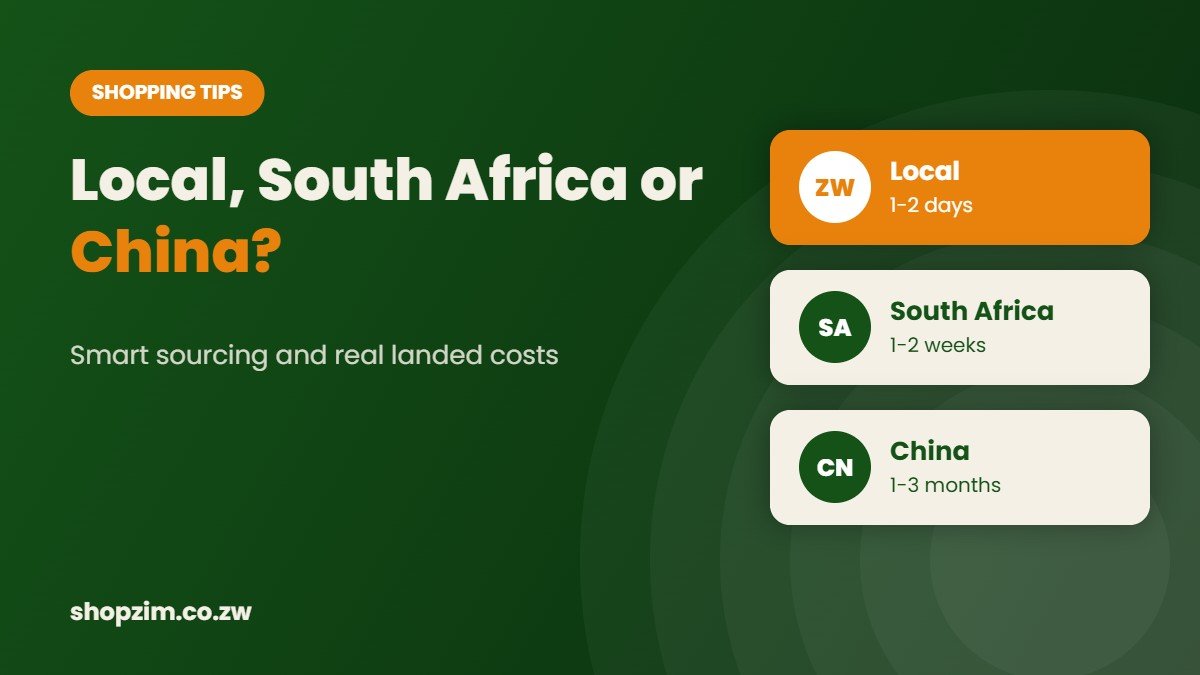
| Waiting time | Same day to 2 days | Days to 2 weeks | Weeks (air) to months (sea) |
| Price certainty | High | Medium | Low until landed |
| Returns | Easy | Difficult | Very difficult |
| Best for | Everyday and urgent items | Brands and appliances | Bulk and resale |
A simple sourcing routine for your household
- Sort your list into urgent, regular and occasional items.
- Buy urgent and regular items locally from sellers you trust, grouped into planned orders.
- Batch occasional, bigger purchases and compare the landed cost from South Africa or China against the local price.
- Keep a record of what you paid in total, including fees, so you learn which route really saves money.
Watch out for
- Prices that are far below every other seller.
- Agents who will not tell you their rates in writing.
- Paying the full amount upfront to a new supplier with no track record.
- Forgetting that your time also has a value.
For more on hidden costs, see our 5-Hour Wholesale Test.
Let someone else do the importing
At ShopZim we source practical items so you do not have to wait months or worry about freight. Stock is already in Harare, prices are shown upfront, and you can pay with EcoCash, InnBucks or ZIPIT and collect in Belgravia or arrange delivery.