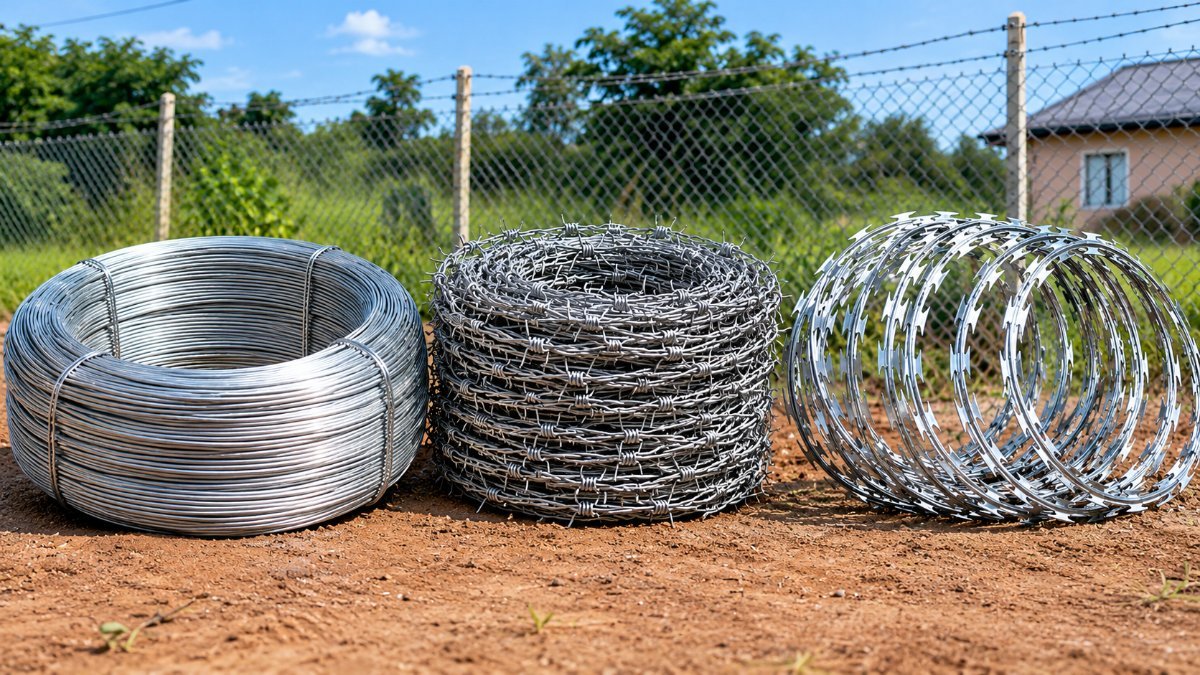
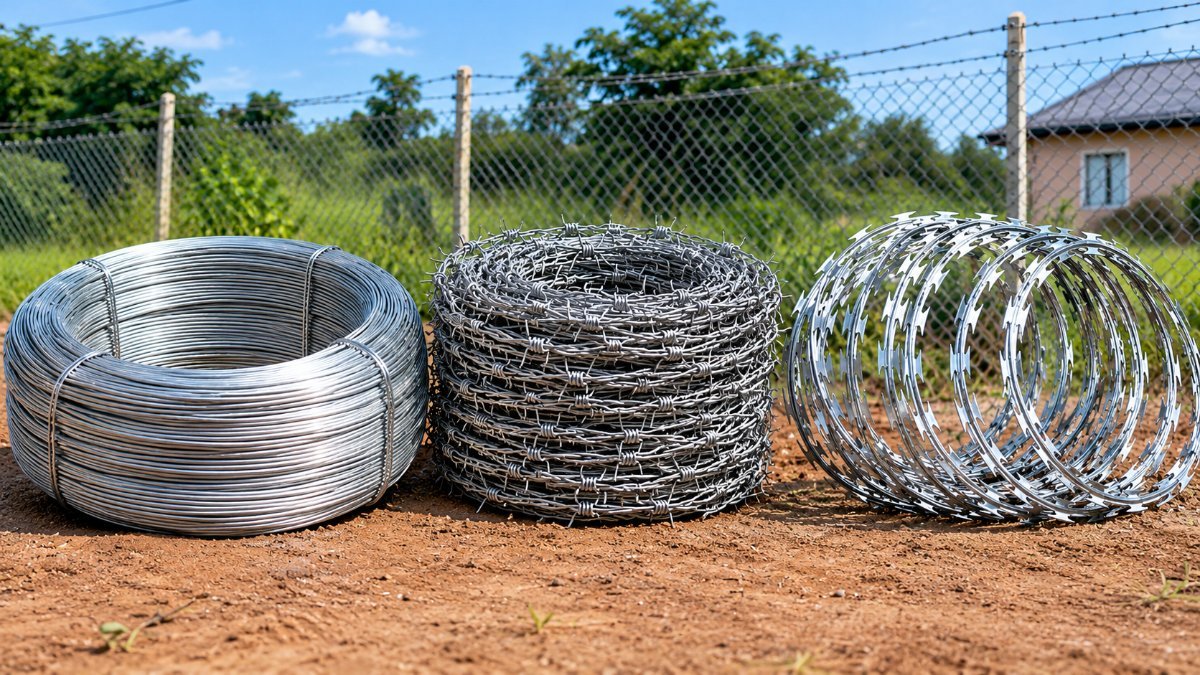
Whether you are securing a commercial property, fencing off agricultural farmland, or constructing a high-security perimeter, choosing the right wire material is critical. Wire fencing serves as the first line of defense for property boundaries, livestock management, and security reinforcement. However, with options ranging from smooth tension wires to high-tensile barbs and razor coils, selecting the exact type and gauge can feel overwhelming.
This comprehensive buying guide covers the distinct uses, technical specifications, standard sizing, quality metrics, and critical precautions to inspect before purchasing Galvanized Plain Wire, Barbed Wire, and Razor Wire.
1. Galvanized Plain Wire
Galvanized plain wire is a smooth, versatile steel wire that undergoes a chemical galvanization process—coating the steel core with a layer of zinc to shield against moisture, oxidation, and rust. It forms the backbone of structural trellising, electrical grounding, net-weaving, and tension support across fences.

Primary Uses
- Tension Lines & Support: Acts as the horizontal top, middle, and bottom straining wire for chain-link, wooden, or field fences to maintain structural rigidity.
- Agricultural Trellising: Provides sturdy support lines for orchards, vineyards, and climbing crops (e.g., tomatoes, passion fruit).
- Mesh & Basket Manufacturing: Used as the base material for weaving chain-link mesh, welded wire mesh, and gabion baskets.
- Binding & Baling: Used extensively in construction and agriculture for tying rebar, bundling timber, or securing loads.
Standard Sizes & Specifications
Plain wire is measured primarily by diameter in millimeters (mm) or standard wire gauge (SWG).
- 2.0 mm (approx. 14 SWG): Highly pliable yet sturdy. Ideal for lighter tensioning, crop binding, fruit trellising, and light mesh weaving.
- 2.5 mm (approx. 12 SWG): The industry standard for high-tension perimeter lines, agricultural fence support, heavy-duty livestock enclosures, and gabion box reinforcement.
- Galvanization Grades: Available in Commercial Galvanized (light zinc coating for low-moisture environments) and Heavy Galvanized / Hot-Dipped (thick zinc coating, typically 200–300 g/m², for harsh outdoor or coastal climates).
2. Barbed Wire
Barbed wire features two central strand wires twisted together with sharp barbs arranged at regular intervals. It is designed to create a physical deterrent against intrusion and animal straying without causing fatal injury.

Primary Uses
- Livestock & Agricultural Fencing: Keeps cattle, sheep, and horses contained while deterring wild predators.
- Perimeter Security: Installed along the top of security walls, chain-link fences, or timber posts around industrial sites, farms, and storage yards.
- Boundary Demarcation: Defines clear property lines over vast rural distances at a relatively low material cost.
Types, Sizes & Specifications
- Wire Gauges: Typically constructed using core wires between 1.6 mm and 2.5 mm. 2.0 mm x 2.0 mm and 2.5 mm x 2.5 mm double-strand configurations are standard for high-tensile agricultural use.
- Barb Spacing: Standard spacing ranges between 75 mm (3 inches) and 150 mm (6 inches). Closer barb spacing offers higher security for perimeter walls.
- Strand Formats:
- Traditional Double-Twist: Both wires are twisted in a single continuous direction.
- Reverse-Twist: The strands twist in opposite directions periodically, preventing unraveling and allowing higher tension without sagging.
3. Razor Wire (Barbed Tape)
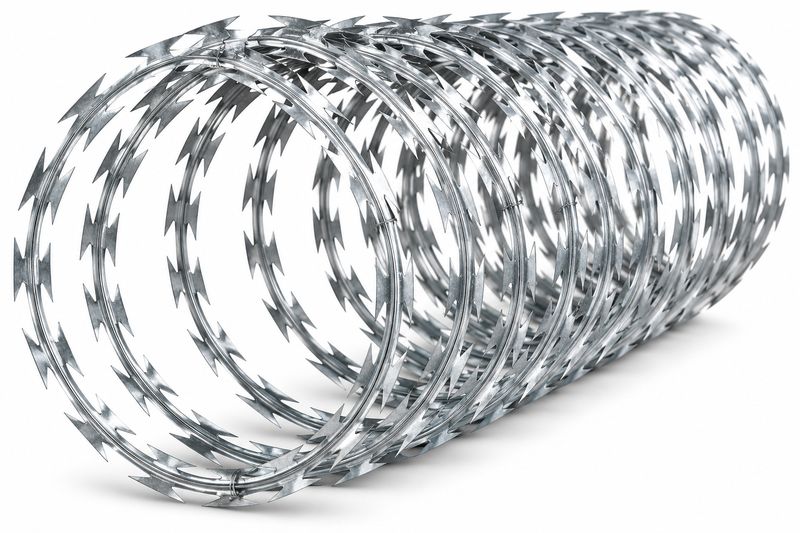
Razor wire (often referred to by the trade name Concertina wire) consists of a high-tensile central core wire cold-crimped with sharp, punch-stamped steel tape blades. Unlike traditional barbed wire, razor wire is engineered to cause severe lacerations and entangle anyone attempting to climb or cut through it.
Primary Uses
- High-Security Perimeters: Deployed at military bases, prisons, government facilities, power plants, and border crossings.
- Commercial & Industrial Security: Mounted atop perimeter walls, anti-climb mesh, or gate structures around warehouses and industrial zones.
- Emergency Demarcation: Rapidly deployed directly onto the ground to form immediate barriers during high-risk security operations.
Sizes & Blade Profiles
Razor wire is supplied in coiled form and rated by coil diameter and blade profile:
- Coil Diameters: Standard sizes include 450 mm, 700 mm, 900 mm, and 980 mm.
- Blade Types:
- BTO-22 (Medium Blade): The standard commercial security blade with 22 mm blade length.
- CBT-65 (Heavy/Long Blade): An aggressive 65 mm blade used in maximum-security military installations.
- Configuration Formats:
- Flat Wrap: Sits flat against existing fence planes; ideal for gates or narrow urban spaces.
- Single Coil: Spiral coils without clips, used for lower-threat boundaries.
- Concertina (Crossed Clips): Adjacent coils are clipped together at regular points. When expanded, it forms an anti-climb, three-dimensional concertina tube.
4. Key Factors & Things to Check When Buying
To ensure your investment lasts and performs under outdoor conditions, follow this inspection checklist before purchasing plain, barbed, or razor wire:
A. Zinc Coating & Galvanization Quality
- Hot-Dipped vs. Electro-Galvanized: Electro-galvanized wire has a bright, smooth finish but a thin zinc layer that rusts within 1–3 years outdoors. Always opt for Hot-Dipped Galvanized (HDG) wire for permanent outdoor installations, as it resists corrosion for decades.
- Zinc Mass Standard: Check the product specification sheet for zinc density. Standard commercial wire carries roughly 60–90 g/m², whereas heavy-duty galvanized wire carries 200 g/m² or more.
B. Core Wire Tensile Strength
- Low Carbon Steel (Soft Wire): Easy to bend by hand; suitable for tying or manual binding, but sags over time when stretched between long post spans.
- High Tensile Steel: Difficult to bend without tools; retains elasticity under changing temperatures and resists impact from heavy livestock or forced intrusion.
C. Weight vs. Length Verification
Wire is frequently sold by roll weight (kg) or linear length (meters). Dishonest suppliers may reduce the wire gauge to fake coil length.
Rule of thumb: Measure the outer diameter with a digital micrometer or caliper upon delivery to verify that a 2.5 mm plain wire measures a true 2.5 mm across the zinc coating.
D. Barb & Blade Integrity
- Inspect barb tightness on barbed wire: the barbs should not slide along the main strand when pushed forcefully with pliers.
- Verify blade thickness on razor wire: ensure the steel tape is tightly crimped to the high-tensile core wire so the razor strips cannot be peeled away.
5. Summary Comparison Matrix
| Wire Type | Key Strength | Common Gauges / Sizes | Security Level | Best Applications |
|---|---|---|---|---|
| Galvanized Plain Wire | High flexibility, smooth tensioning | 2.0 mm, 2.5 mm | Low (base support) | Fence tensioning, trellising, binding, mesh making |
| Barbed Wire | Cost-effective physical barrier | 1.6 mm – 2.5 mm core; 75–150 mm barb spacing | Medium | Agricultural boundaries, livestock control, wall toppings |
| Razor Wire | High-level physical & psychological deterrent | 450 mm – 980 mm coil diameter (BTO-22 / CBT-65) | Maximum | Military, prisons, high-security commercial sites |
Safety & Handling Measures
Working with structural and security wire involves high tension and sharp components. Adhere strictly to these safety precautions during handling and installation:
- Personal Protective Equipment (PPE): Always wear heavy-duty leather riggers' gloves, safety goggles, and thick canvas/leather sleeves. Standard cotton or rubber gloves offer zero protection against razor wire tape.
- Controlled Tensioning: Never over-tension plain or barbed wire beyond its rated tensile yield. Snapping high-tension wire can cause severe whipback injuries. Use proper wire strainers (e.g., chain strainers) rather than makeshift tools.
- Razor Wire Handling: Uncoil razor wire using specialized unrolling equipment or two-person teams equipped with handling tongs. Ensure perimeters installed with razor wire carry clear warning signage at regular intervals in accordance with local municipal safety codes.